The Musical Playback Role of a Center-Placed Live Vibe Audio Rack
The Musical Playback Role of a Center-Placed Live Vibe Audio Rack
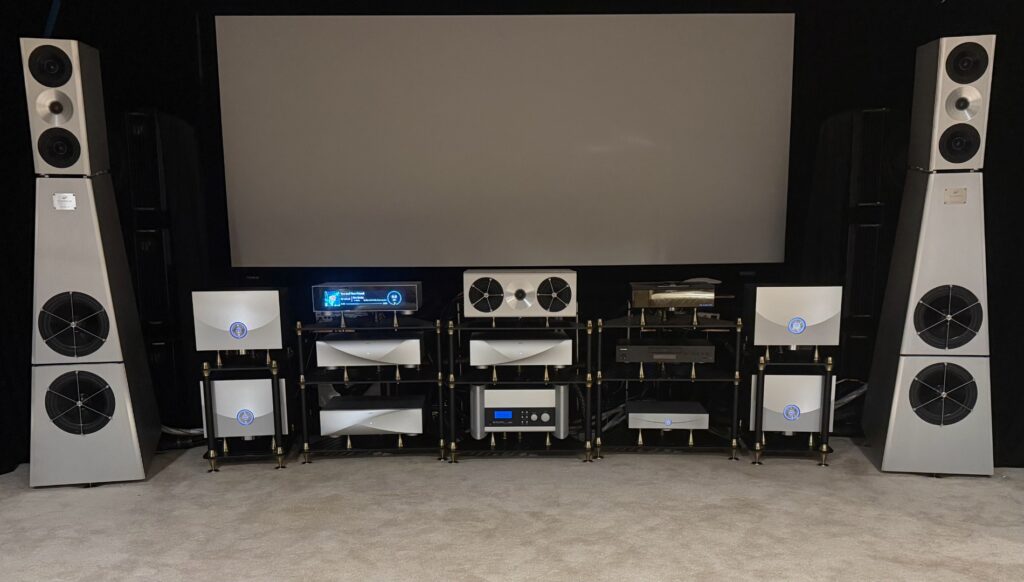
In high-performance audio setups, placing equipment racks between the loudspeakers breeds caution according to the majority. Standard furniture, hollow wooden cabinets, or wide, flat shelving acts like an acoustic mirror. These traditional structures introduce early reflections, smear timing/phase information, and blur the phantom center image.
However, a Live Vibe Audio rack functions entirely differently, serving as a physical and acoustic anchor for the central soundstage rather than a source of sonic diffraction or reflection:
- High Structural Mass & Mechanical Grounding: Specifically engineered for high-speed mechanical energy transfer. They transfer micro-vibrations through brass Audio Points and rigid steel coupling; the framework remains inert. It does not vibrate sympathetically with room pressurization or re-radiate delayed acoustic energy back into space. The vibrating equipment on the rack is never an issue.
- Diffractive Physical Profile vs. Reflective Surfaces: Unlike large, continuous flat panels that bounce acoustic waves straight back to the listener, open-tier mechanical grounding racks feature dense, irregular geometric profiles and use conductive metal materials. These shapes break up and scatter incidental sound waves rather than reflecting a harsh, coherent echo.
- Phantom Center Stabilization: Stereo imaging relies on micro-second timing and phase coherence between the left and right channels to create a 3D vocal or instrumental center image. A high-density, non-resonant structure like the Rhythm Platforms placed dead-center provides a physically stable, non-interactive boundary that prevents acoustic “ghosting” or cabinet smear. This permits solo vocalists and center-placed instruments to lock in a position with exceptional focus, weight, and depth.
For twenty-six years, I have used the original Star Sound Sistrum Platforms that uses a specific cold rolled chemistry for the steel shelves with the brass Audio Points™ for initial component contact. Sistrum was the first design of a rack that vibrates along with the components and was the predecessor to the Live Vibe Rhythm system. We found on both designs when holding a shelf in the air with nothing attached, when tapping the shelf, it rings. Using this method, CDs, DACs, and amplifiers also ring. The ringing disappears using the Laws of Coulomb, physics, and Laws of vibration.
The Platform function acts as an airborne acoustic collector. Ambient energy travels down the high-speed grounding pathways along with the component’s internal mechanical resonance to Earth’s ground or the greater mass such as flooring.
There is a significant difference between how that shelf behaves when you ping it in free air versus how it functions when fully coupled in the balance of the racking system.
This is a breakdown of what is happening physically:
1. Why it Rings in Free Air
When you hold the bare Sistrum/Star Sound Rhythm shelf in your hand and tap it, you are evaluating an unconstrained, unloaded system.
- In free air, the shelf has maximum freedom to resonate at its natural fundamental frequencies.
- The ‘white steel’ shelf made from high-density metal with low internal damping establishes frequencies that are inaudible to the human ear. The energy stays trapped in the material, bouncing back and forth until the acoustic decays and noise dissipates.
2. Does it attract ambient room information?
Yes. Any flat, rigid surface sitting in a sound field acts as an acoustic boundary like a microphone diaphragm:
- Sound pressure waves generated by your loudspeakers hit the surface area of the smooth metal shelf.
- That acoustic energy absorbed by the shelf converts airborne sound into micro-mechanical structural vibrations.
- If the shelf sits at a frequency that aligns with room modes or speaker output, it will passively react as an absorber for ambient energy and function with all volume levels.
3. Is ambient energy grounded along with equipment resonance?
Yes. From a physics perspective, energy is energy—the crystal lattice of the metal shelf does not care where a vibration enters from:
- Direct mechanical transfer of noise from transformer hum, power distribution, optical drive spin, air born, or chassis vibrations pass through the Audio Points.
- Airborne acoustic excitation created from sound pressure hit the top or bottom face of the shelf. The resonance then travels through the rod system. The rods are the mechanical conduit pathways to ground.
Once energy enters the metals, it becomes structural kinetic energy. The core principles of physics and Live Vibe design philosophy rely on the mechanical ground pathways to become congruent serving one purpose in the functionality of the design.
The “Under Load” Transformation
Fully assembled, the free-air rings you hear changes in two major ways:
- Mass Loading & Node Shifting: As soon as you place heavy audio equipment on the Audio Points, you alter the mass distribution and boundary conditions of the shelf. This heavily dampens the free-air ringing frequency and shifts any remaining resonance peaks to completely different lower/less excitation-prone frequencies. The frequencies are inaudible.
- Continuous Draining: Instead of acoustic energy bouncing back and forth inside a typical isolated shelf, the mechanically coupled shelf completes the circuit ending at the floor. The evacuation of energy is instantaneous.
While the shelf catches airborne room energy due to its materials and surface area, a functioning mechanical grounding system continuously evacuates that energy into the floor mass alongside the chassis vibration of your gear.
Are you experiencing any audible ringing or smearing in your setup that made you evaluate the shelf isolated, or were you accessing the physical design theory?
- Solid, high-velocity transfer materials (brass points and steel rods) provide a low-impedance mechanical path to the floor mass.
- Because energy naturally moves toward the path of least resistance, structural vibration in the shelf will flow downward through the points, rods, and floor points much faster than it can build up and re-radiate back into the room as air sound.
The AUDIBLE RESULTS from a highly respected design theorem is FUNCTIONALITY.
Live-Vibe Technology™ adapts to musical instruments, fan motors, transformers, electrical panels, air-conditioning compressors, and other equipment. For example, it can help manage resonance in audio components and loudspeaker systems, reduce vibration from a fan motor or transformer, and limit vibration transferring from a compressor to the surrounding structure. By managing mechanical energy, the technology can reduce component operating temperatures and improve operational efficiency. In audio systems, these measurable and audible benefits may produce clearer imaging, tighter bass, management of all frequencies from top to bottom, and a more engaging listening experience. Backed by thirty-five years in business, we stand behind our products and their performance. The products, functionality, and performance lead the way.